Try again on a desktop for the best experience.
Enhancing user retention of Too Good To Go
Improving user retention through a reward system and increasing user’s control over the orders on the TGTG app
A UX concept project to improve retention on Too Good To Go by addressing three key user needs: clearer expectations about bag contents, smaller portion options for solo users, and a visible reward system that motivates repeat orders.
Team
2 UX|UI designers
Duration
6 weeks
Tools
Figma, Notion
Year
2024
My role
As the UX/UI designer on this project, I led the end-to-end process: conducting user research, analyzing data, identifying insights and pain points, and designing solutions that balance user needs with business goals. I collaborated remotely with my teammate throughout the design process.
Impact
The redesign improved user confidence and reduced food waste, introduced a visible reward system to encourage repeat engagement, and made surprise‑bag experiences more transparent, boosting usability, retention, and overall user engagement.
Introduction
Too Good To Go is a food rescue app that connects users with local stores offering surplus meals. While the concept is appealing, some users don’t return to the app even after their first use. Why is this happening, and how can we improve the retention rate?
The problem, in their words
What drove users away?
Lets have a look at the online reviews of TGTG
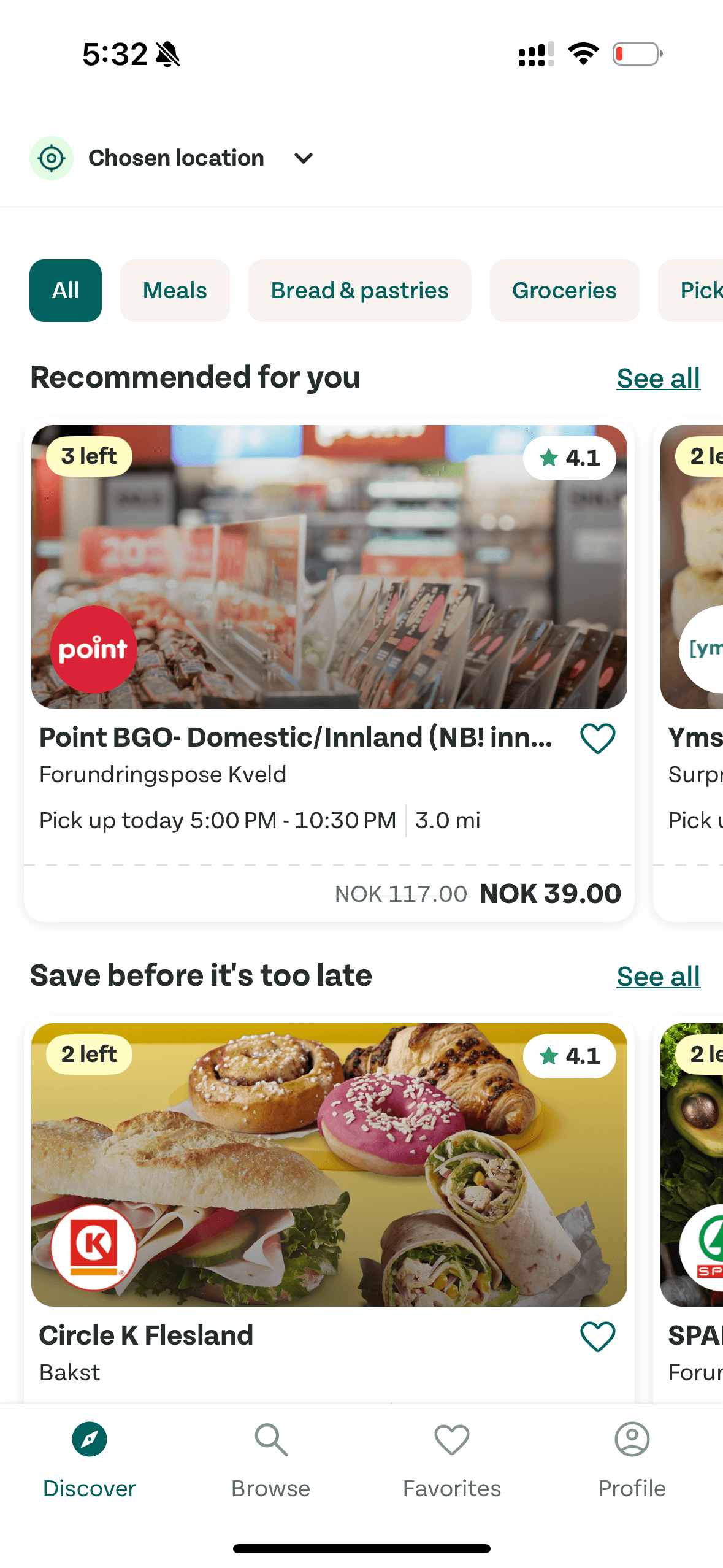
From user feedback, we found several pain points shared in their own words. Users often lose trust and stop using the app when the surprise bag feels unreliable whether it doesn’t match their dietary needs, doesn’t fit their schedule, or lacks expected quality and value.
Poor first experiences lead to drop-offs and discourage new users.
25% of users gave a 1-star rating, mainly due to food quality, portion sizes, and lack of transparency.


A*** D*****
Bad food… lots of pork dishes.
|

A*** D*****
our assumptions
What we thought we knew...
We started with a few assumptions, based on our observations about why users might not return after their first order.
Validated assumptions
Limited time windows and locations may make pickups hard for customers.
Customers want clear expectations, food types, quality, expiry dates, and images, to feel their purchase is worth it.
Users may not return if they don't see their environmental impact, so more encouragement is needed.
Unproven assumptions
Confusing navigation makes it hard for users to find and reserve items.
Customers may want to filter options, save preferences, and get personalized recommendations.
Without strong incentives, customers may leave for services with better loyalty programs.
Validating our assumptions
But what’s really stopping TGTG users from coming back?
Lets talk to real users
To better understand the answer to this question, we conducted interviews with +5 users to uncover their real pain points and gain deeper insights. Our goal was to find out:
|
|
|
User interview takeaways
User interviews revealed that the biggest challenges were feelings of wastefulness, limited pickup times, and lack of transparency.
Users Struggle to See the App's Environmental Impact Because It’s Not Visible or Noticeable
The app lacks transparency about food quality, as users often expect better than what they receive, because many former users reported low-quality items, leading to decreased interest in the app.
Lack of available locations and limited time frames make users feel restricted, especially in less busy areas or for those with tight schedules.
Money savings alone aren’t enough motivation for users because they feel like they are still contributing to food waste.
Users could be more engaged with notifications about new offers from highly rated places they've previously purchased from or marked as favorites, as they often miss out on these deals.
Lack of transparency in the contents of each bag makes users unsure about the actual value of their order, leading to lower conversions.
Personas
Who are the TGTG users, and what’s making them stay or leave?
We grouped our users into three main archetypes to better understand their needs and behaviors.

The Cost-conscious foodie
Mia, 21
As a low-income student in the suburbs, she loves eating out but has limited options and often misses favorite deals. Leftovers pile up, so she wants to pay only for what she needs. Food allergies make the lack of bag content info frustrating.
“I love eating out, but as a student, I can't always afford it, that's why I use TGTG to get restaurant food for less.”
Sarah, 40

The Busy commuter
Niko, 27
A tech-savvy professional with a tight schedule uses TGTG to discover meals easily. He values convenience over price, but fixed and limited pickup times often don’t align with his daily routine.
“TGTG was a good fit for my busy schedule, saved me money, and let me try new foods while reducing waste.”
Sarah, 40

The Eco-minded consumer
Sarah, 40
Sarah uses TGTG for sustainability, but she’s unsure of her impact. Living alone, she often gets too much food, causing waste. She also wants clearer info on food quality for health reasons.
“I want to do my part to reduce food waste and help the environment, but it must be simple and fit my busy life.”
Sarah, 40
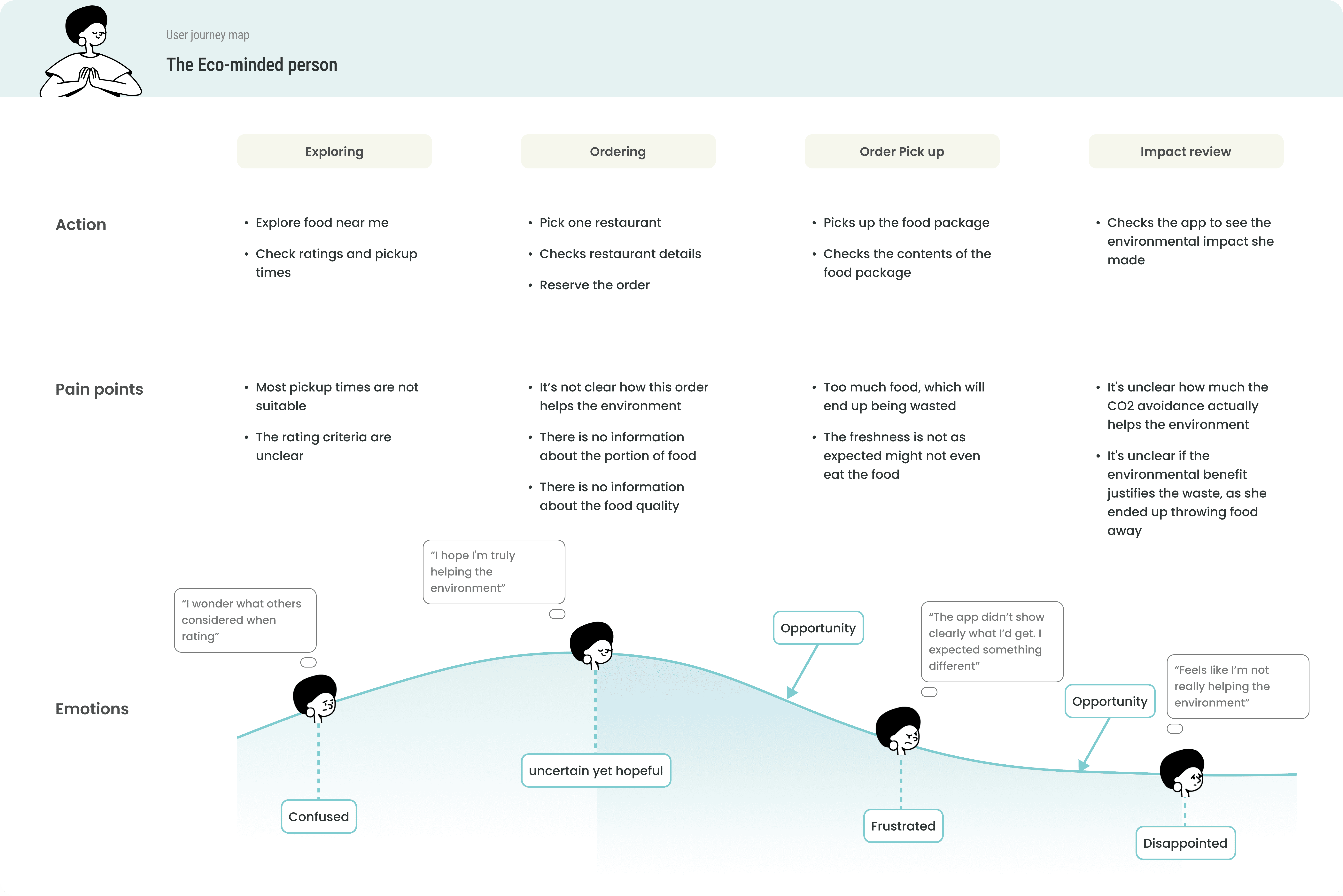
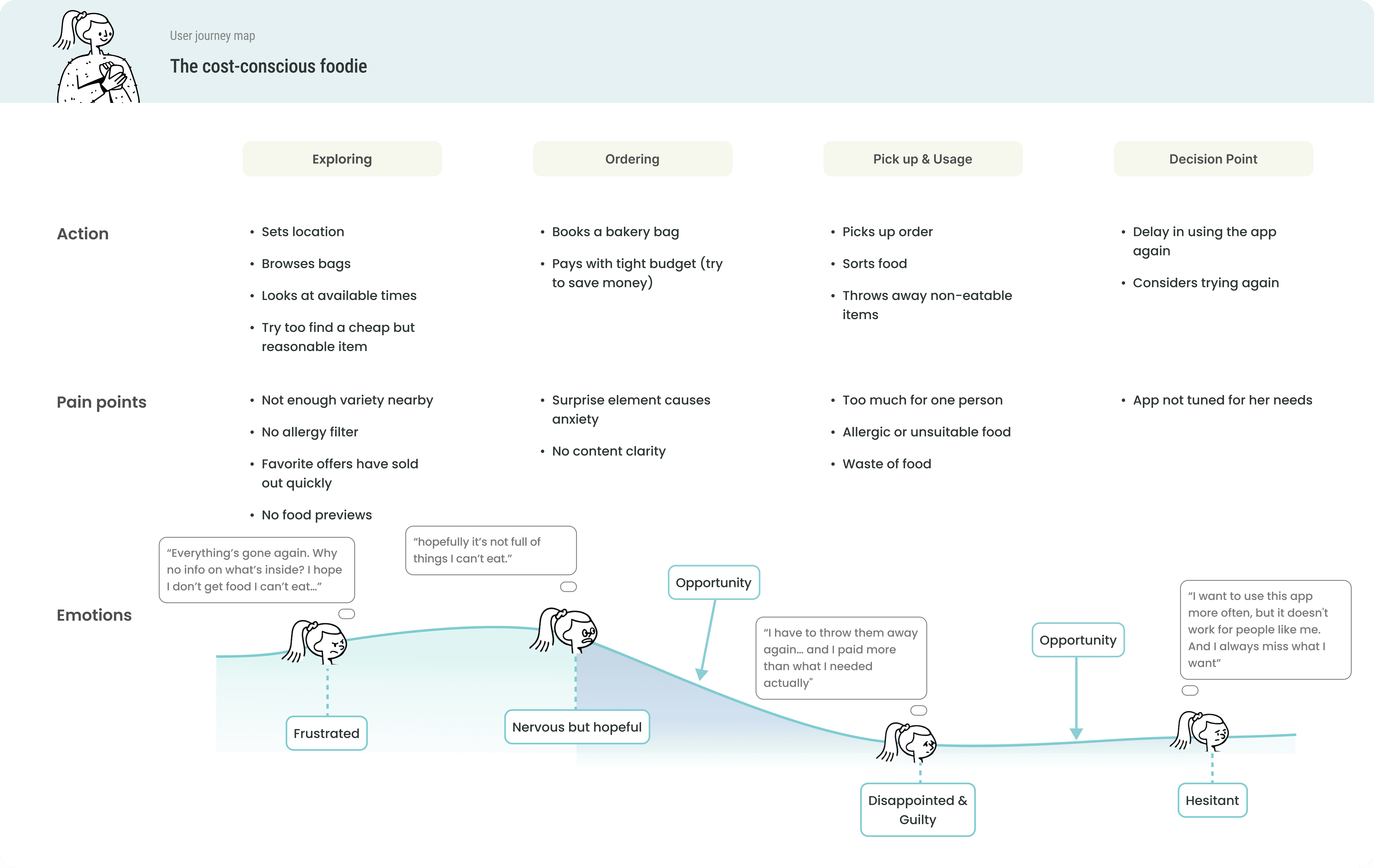
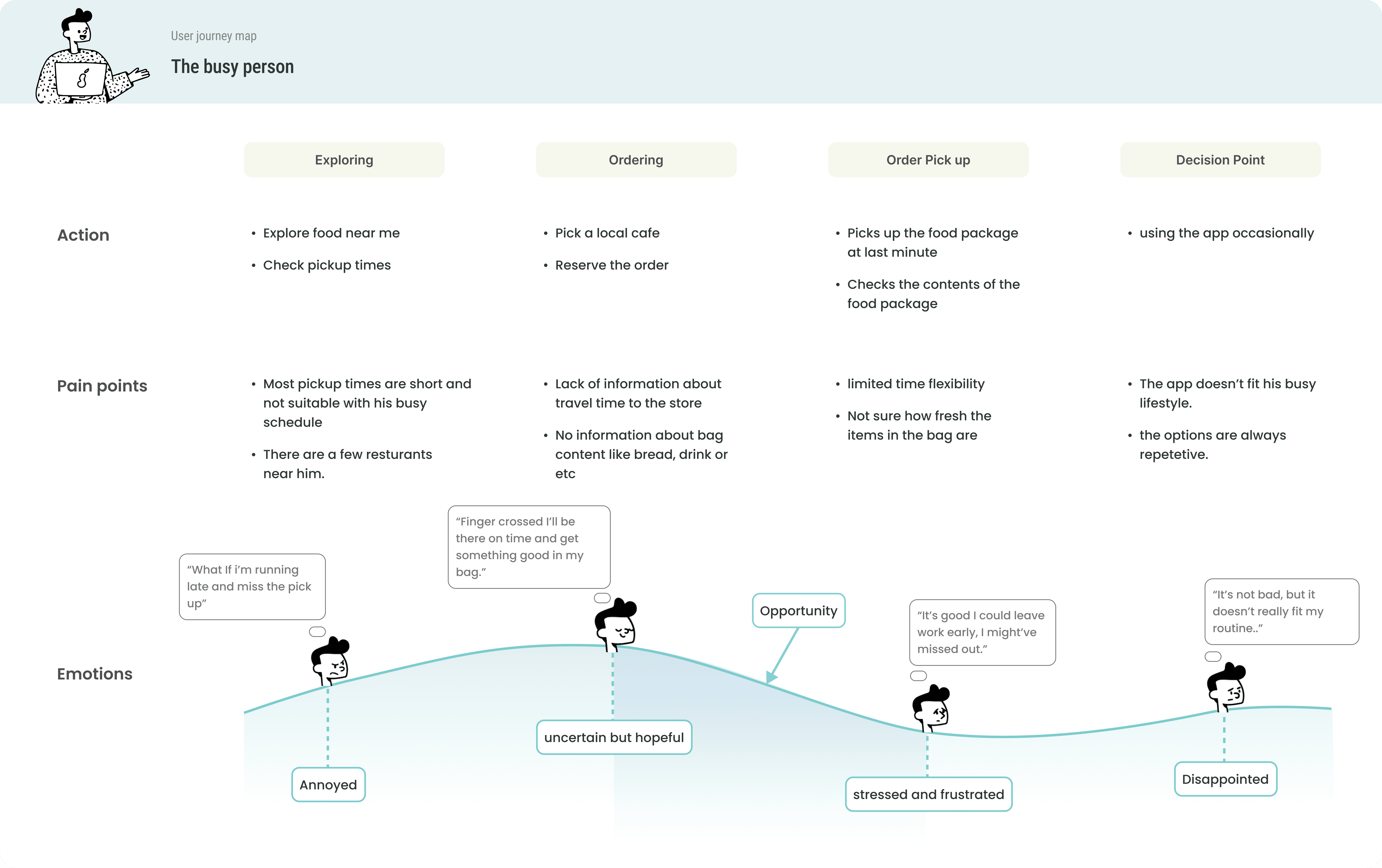
User journey maps
The real route through TGTG
How are these users navigating the TGTG experience?
The problem
The core challenge
Many users stopped using Too Good To Go after just one or two tries.
Unclear bag contents, no clear sense of impact, and oversized portions often led to frustration and drop-off.
“I ended up throwing half of it away… it felt wasteful, and that’s exactly what I was trying to avoid.”
“I didn’t really know what I was paying for.”
Competitive analysis
TGTG is not the only app trying to save the planet,
competitors go further by boosting satisfaction through personalization, better choice control, and faster updates that help reduce waste.
Goals
The goal is to explore how competitors encourage users to stay engaged with the app and what factors contribute to user satisfaction



Boosting engagement
Using gamification elements that promote more conscious choices and highlight the environmental impact of each purchase. They also send notifications from favorite stores so users don’t miss their favorite items, which helps keep them engaged.
More accurate choices
Offering personalized features and the option to choose specific items from a store’s list, the ability to filter items based on food allergies and wider time windows for order pickups that help users make more accurate food choices. This leads to greater satisfaction, as users are more likely to get what they want, and it also reduces food waste by minimizing unwanted orders.
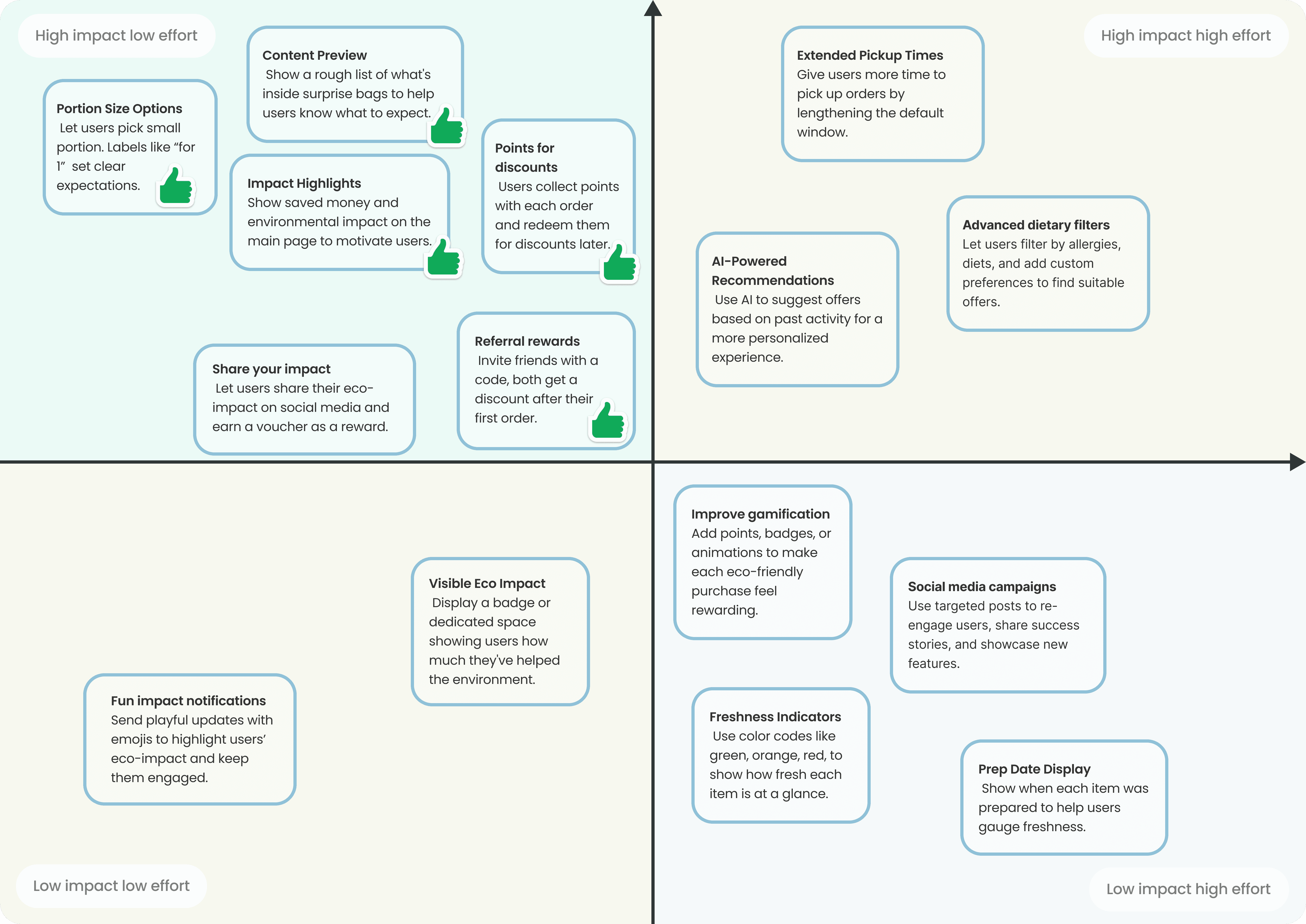
Impact effort map
What’s worth doing first? An impact-effort check
During the ideation session, we generated many ideas to address the problem and narrowed them down to a few with the greatest impact and minimal effort to implement.
Visual Design
Users now have more control when choosing surprise bags
With single portion options and clearer content hints, users enjoy more control over portion size and expectations, without spoiling the surprise.
Before
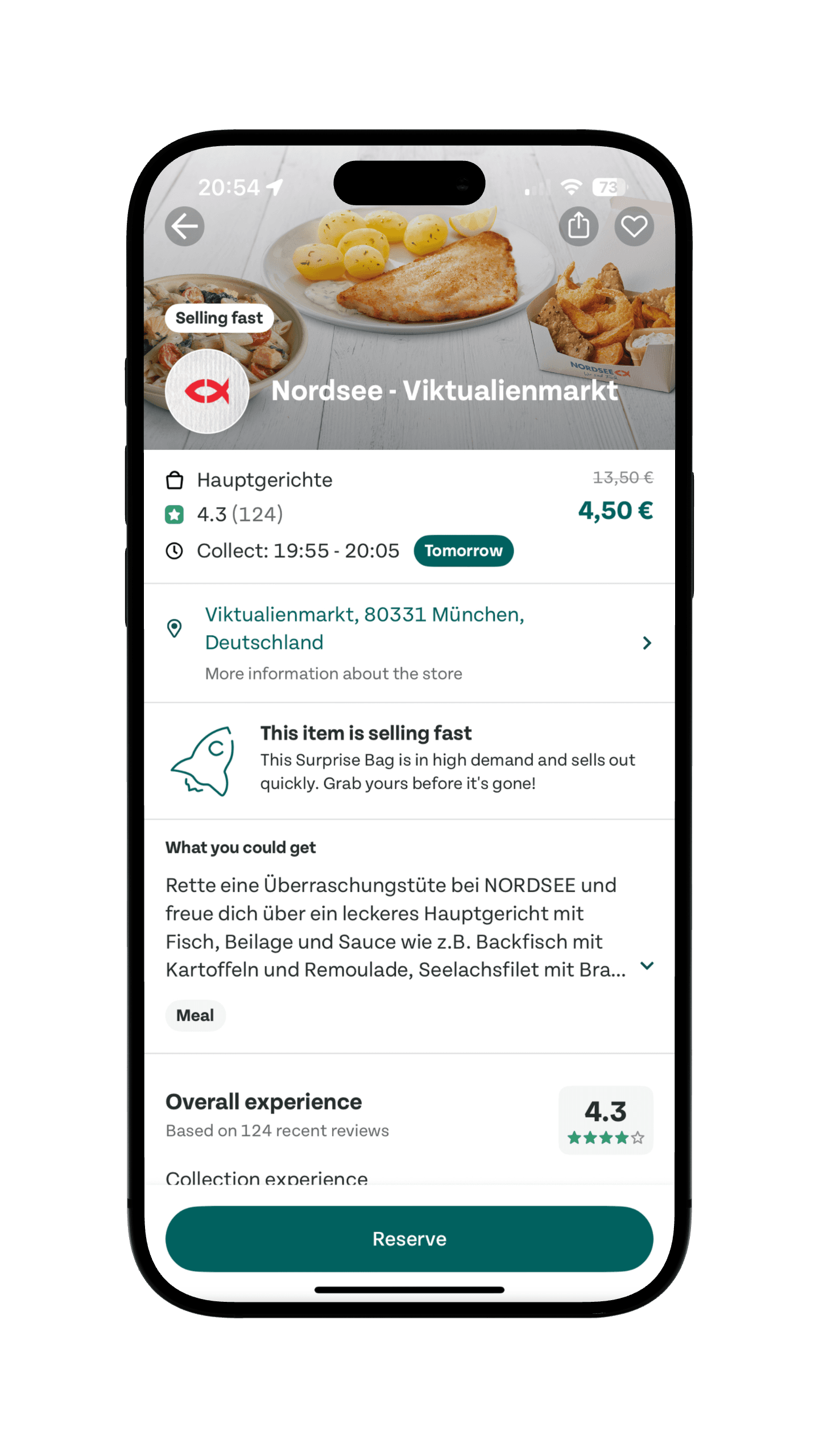
"I’m always worried it’ll be something I can’t eat because of my food restrictions."
“Whenever I get a bag, it’s too much, I throw some away and think I could’ve just bought what I actually wanted."
Bag contents are sometimes too much for solo users, leading to waste.
Users often feel uncertain when ordering, simply because they have no clue what to expect.
What was the first idea?
Our first idea was offering portion size options for surprise bags, so users can pick what fits their needs, save money, and reduce food waste.
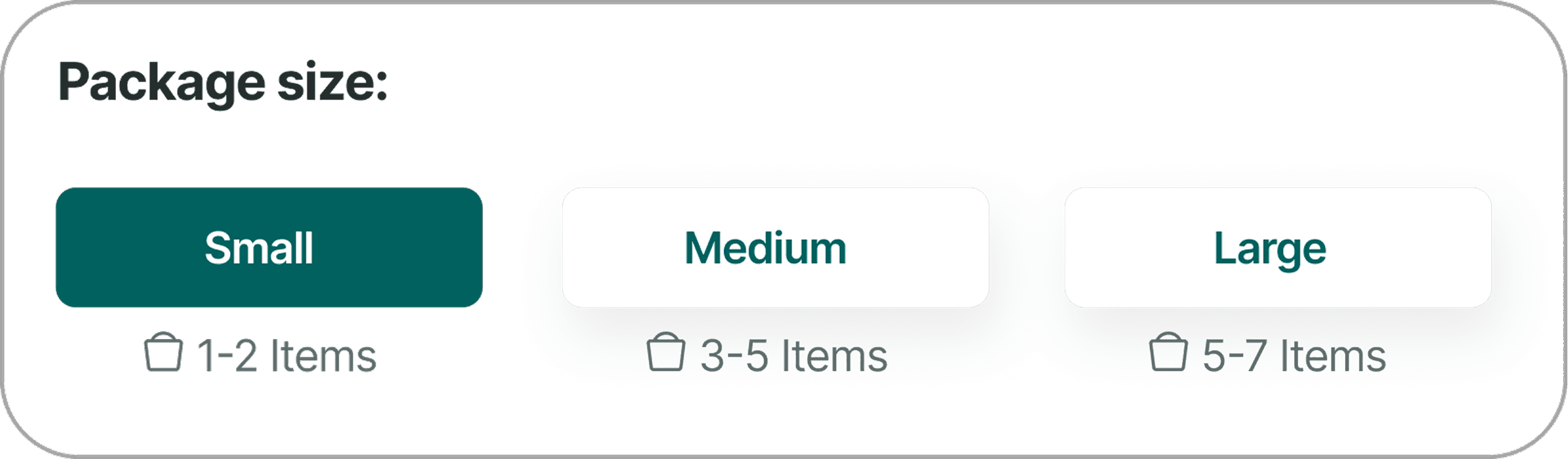
But we found this idea had some challenges.
When ‘Medium’ means different things
Defining small, medium, and large bag sizes turned out to be tricky, these are relative terms, and without clear standards, they risk causing mismatched expectations between users and sellers.
It’s harder for businesses to decide what to include in each size of surprise bag
Users might have expectations about the sizes and end up disappointed, leading to lower satisfaction
Giving users more options to choose from might be confusing rather than helpful.
So we came up with a better solution to minimize these problems.
A more refined idea...
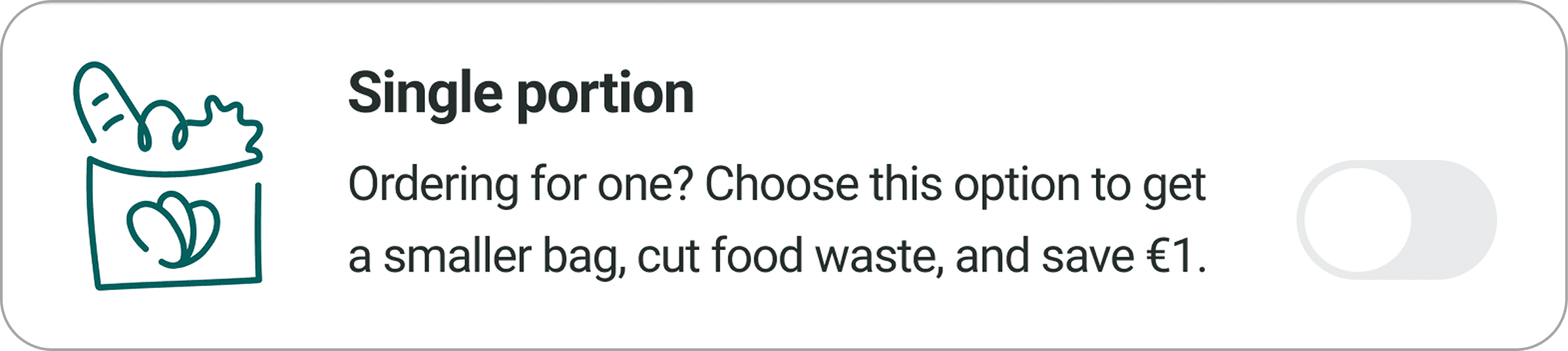
We gave users the option to choose single portions, ideal for those who want a one-person meal and to save extra money while minimizing food waste.

After
Businesses know the food is intended for a single portion, making it easier to decide how much to include in the bag
Users can have a clearer expectation of the food portion size they receive
An ideal choice for those who want a single serving while saving money
Helps reduce food waste
Leaves more surprise bags available for other users
Caught between excitement and clarity
One challenge we faced was understanding users’ true feelings about surprise. While many said they enjoyed the idea, their behavior suggested hesitation—caught between the excitement of not knowing and the desire for clarity.
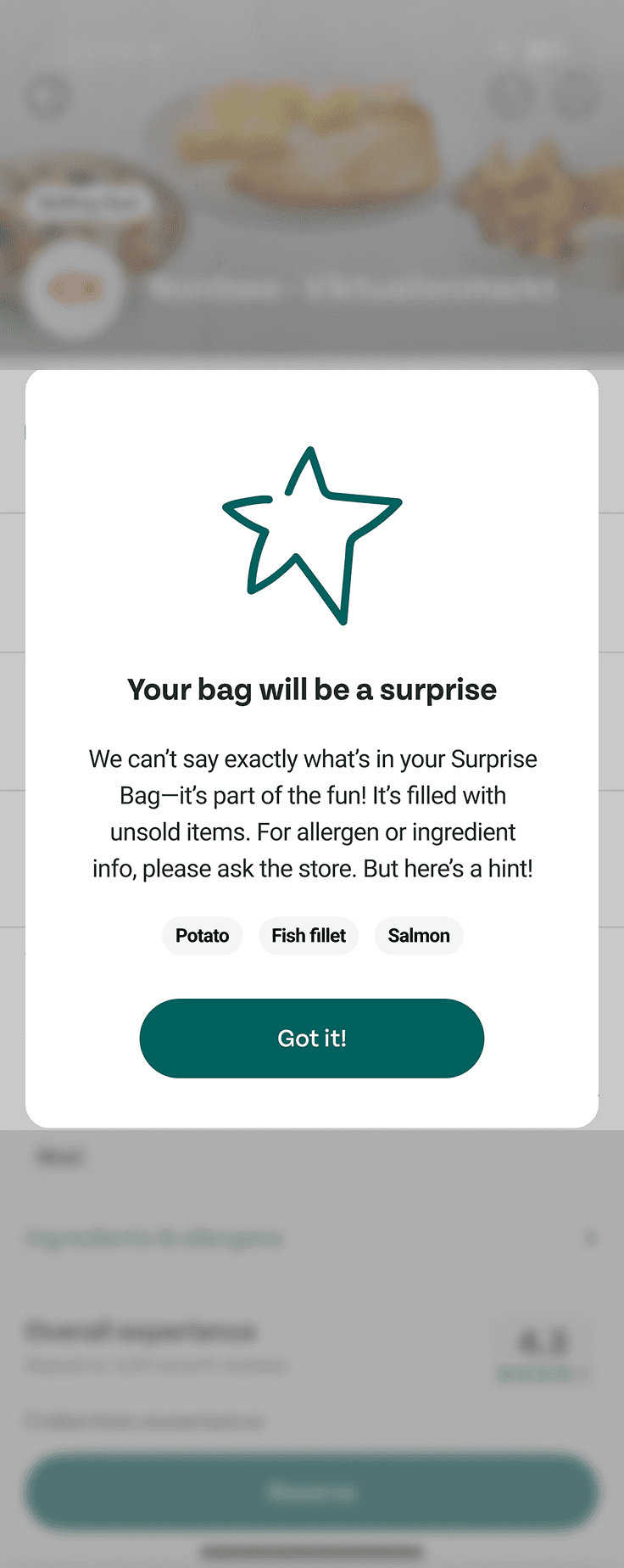
To address this, we increased transparency about the surprise bag contents without compromising the concept, balancing users’ desire for clarity with the excitement of the surprise.


After
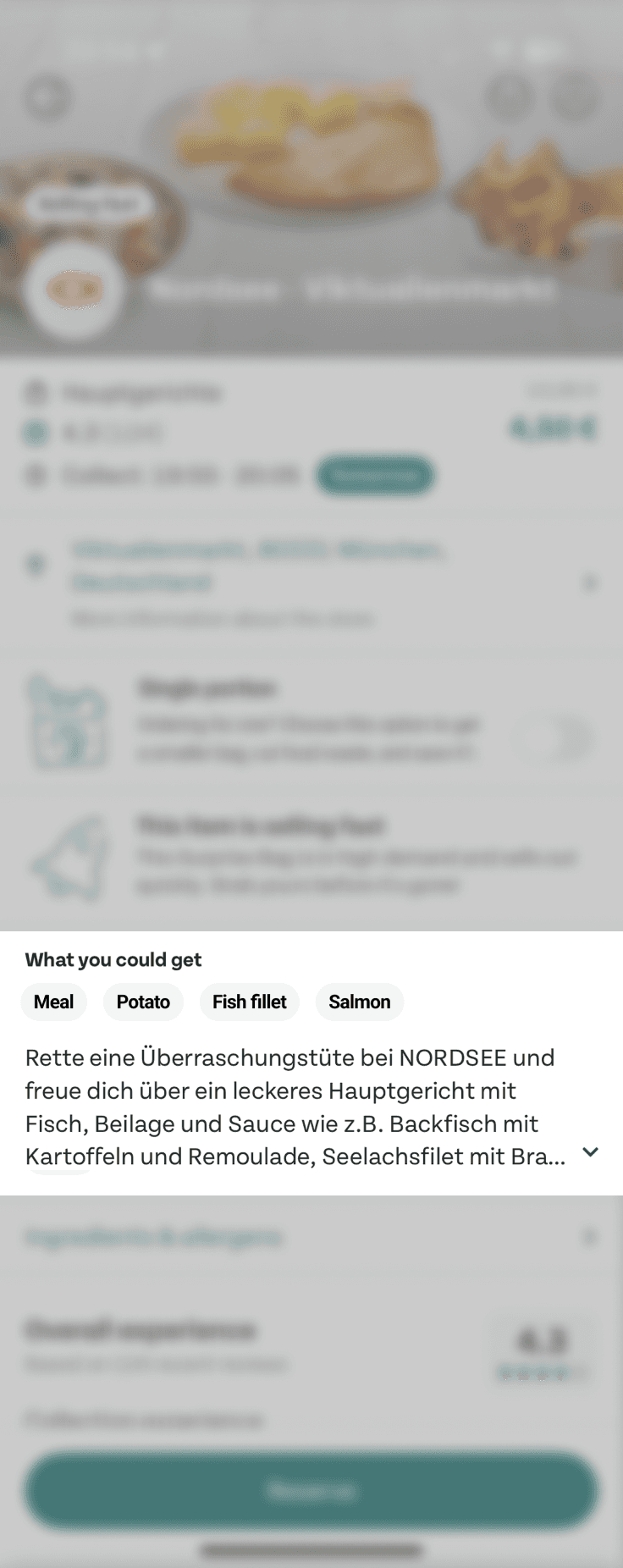
Using the store’s 'What you could get' description, we show tags that visually hint at the possible contents.
It allows users to quickly scan the page without having to read the full description, reducing the chance of missing important ingredients.
Helping users make more informed decisions tailored to their allergies or specific needs.
Introducing a single portion option and clearer bag content tags may require sellers to be slightly more flexible when preparing bags.
Visual Design
We want users to know their impact matters
We added a reward system and made the environmental impact more visible by showing it on the Home page. This helps users see the difference they’re making and understand that their contributions matter.

Before
“I don't think I'm making a difference for the environment.”
Users do not notice their environmental impact.
Money savings alone don’t Motivate users concerned about food waste.
Users have no clear sense of progress or achievement.
There are no rewards for continued use.

After
Implementing a reward system where users are rewarded after collecting enough points.
Clear display of environmental contributions on the Home page.
Highlighting CO2 savings to encourage users to make a positive impact.
Offering point-based discounts could pose a financial risk for the business if too many users redeem rewards frequently.


We showcased two example slides to illustrate the concept.
Users can track their progress and see upcoming rewards. As they earn points, they unlock new levels and receive rewards.
Rewards will be displayed as vouchers in the Loyalty Card section of the profile page.
We took it a step further, making coming back to the app feel even more rewarding
We’ve added rewards to the referral feature and moved it to the profile page to make it more visible and easier to use. This update makes the feature more engaging and gives users another reason to stay active in the app.


Before
The referral feature is underused due to lack of clarity and visibility.
There is little motivation to use the feature, and no rewards for continued engagement.


After
The friend referral feature is now prominently displayed on the profile page, making it easier for users to discover and use.
We added rewards to make the feature more engaging and boost ongoing engagement.
Offering discounts could pose a financial risk for the business if too many users redeem rewards frequently.
After
Points and referral rewards are tracked automatically and displayed in the profile and loyalty pages.


User test
Which elements stood out, what confused
To evaluate our initial design concepts, we ran 5-second and preference tests. Overall, users responded positively to the reward system and having more control over their orders. However, some areas still needed improvement to enhance clarity and usability.
"I like the idea of a reward system, earning points I can use later while also helping the environment makes it feel like I’m getting rewarded for doing something good."
Single portion feature
We tested the first version of the single portion feature and noticed that some users didn’t understand what it was for. It wasn’t clearly explained, and was easy to overlook.

First iteration
“I’m not sure what this single portion means or how I’m supposed to use it!”
The initial design was confusing for users and lacked clarity.
Unclear call to action
Users didn’t understand the feature because the description wasn’t clear.

Second iteration
we included a short description to make the feature easier to understand.
Short, easy-to-understand title.
Improved CTA button
Bag content hints
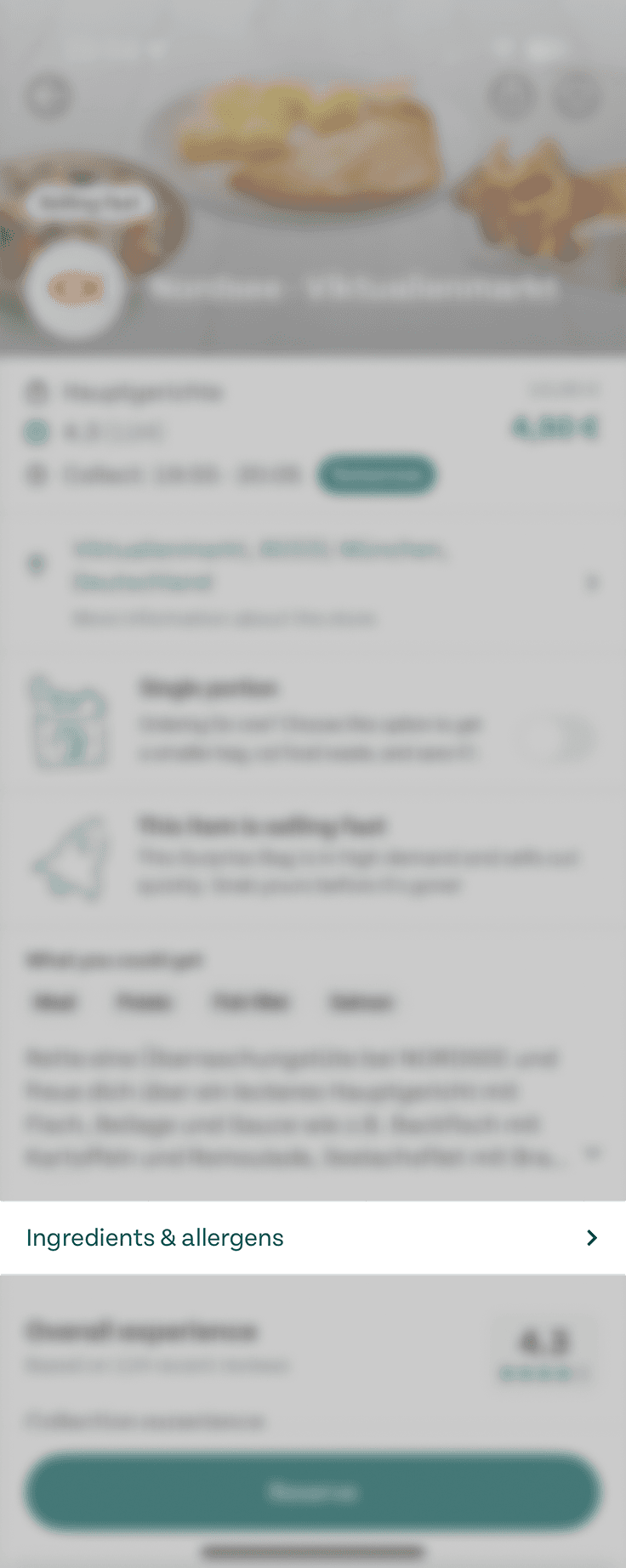
For the bag content hints, we had two placement ideas for the tags. To find out what users preferred, we ran a preference test. We discovered that users preferred seeing the tags directly in the “What You Could Get” section, rather than having to click into the ingredients and allergens to find them.
Lessons learned
Turns out, it’s not just about the environment
We always assumed that most users of TGTG were driven by environmental concerns and a desire to help the planet. But we discovered something surprising.
Many of our users turned out to be young students or early-career professionals, often single, whose primary motivation was saving money. Most of them were looking for affordable meals for just one or two portions.
Even more interesting: while we expected people to be excited about getting “more food,” some users actually felt frustrated by the large portion sizes. Many mentioned that the excess food often went to waste, which defeated the purpose for them.